Typing tests can be useful, but the length of the test changes what the result actually means.
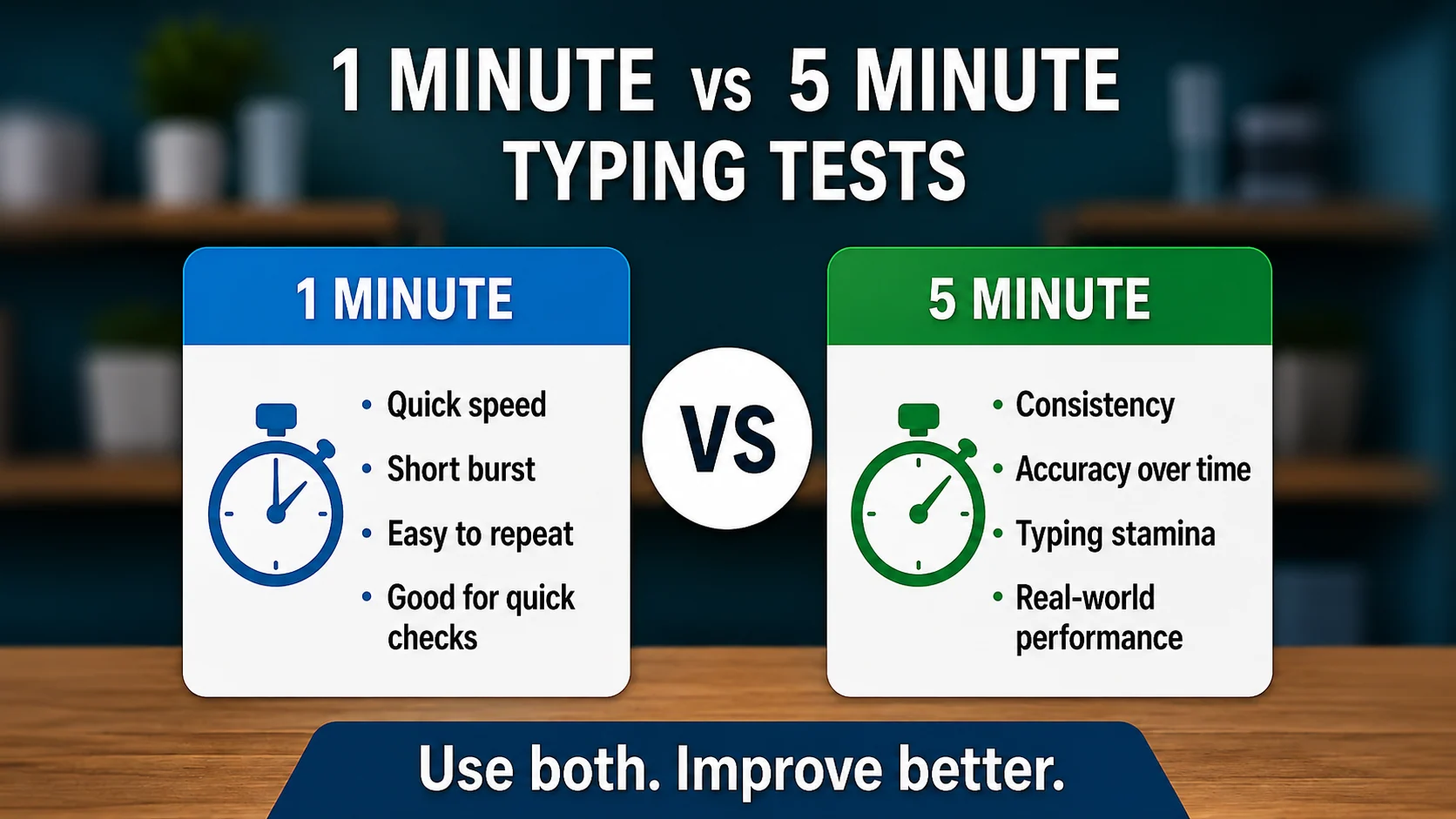
A 1-minute typing test can show your quick typing speed. A 5-minute typing test gives a better picture of consistency, accuracy, rhythm, and whether your typing holds up when you cannot rely on a short burst of focus.
Both tests are useful, but they answer different questions.
A 1-minute test shows how fast you can type in a short burst. A 5-minute test shows how well you can keep typing accurately over time.
If you are trying to improve your typing for work, study, admin tasks, emails, or everyday computer use, understanding the difference can help you practise in a smarter way.
The quick answer
A 1-minute typing test is best for:
- Quick progress checks
- Measuring short-burst WPM
- Testing speed under light pressure
- Comparing results often
- Beginner-friendly practice
A 5-minute typing test is better for:
- Measuring consistency
- Testing accuracy over time
- Spotting tiredness or tension
- Checking real-world typing control
- Preparing for work or study tasks
If your 1-minute score is much higher than your longer-test score, your issue may not be speed. It may be stamina, rhythm, accuracy, or weak-key control.
What a 1-minute typing test shows
A 1-minute typing test is short, simple, and easy to repeat.
It gives you a quick snapshot of your typing speed and accuracy. This makes it useful when you want to check your progress without spending much time.
A 1-minute test is especially useful if you want to know:
- your current WPM
- your quick typing speed
- whether your accuracy is improving
- whether you are making repeated mistakes
- whether you are ready to move to longer practice
You can use a one-minute typing test as a regular checkpoint.
The strengths of a 1-minute test
The biggest strength of a 1-minute typing test is convenience.
It is quick enough to do before or after a lesson. It is also short enough that beginners do not feel overwhelmed.
A 1-minute test is useful because:
- it is fast to complete
- it gives immediate feedback
- it is easy to repeat
- it helps track short-term progress
- it can motivate learners
For beginners, this can be very helpful. A short test feels manageable and gives a clear result.
The weakness of a 1-minute test
A 1-minute typing test can make your typing look better than it really is.
Because the test is short, you may be able to push hard for one minute. You might get a strong WPM score, but that does not always mean you can type at that speed for a longer task.
A short test may hide problems such as:
- accuracy dropping after two or three minutes
- hands becoming tense
- rhythm becoming uneven
- mistakes increasing with longer text
- punctuation slowing you down
- weaker fingers getting tired
- focus dropping over time
That does not make 1-minute tests bad. It just means they are limited.
A 1-minute test is a snapshot, not the full story.
What a 5-minute typing test shows
A 5-minute typing test gives a deeper view of your typing.
Five minutes is long enough to show whether your technique is stable. It can reveal things that a short test does not show.
A 5-minute test can show:
- whether your speed stays consistent
- whether your accuracy drops over time
- whether you become tense
- whether you rely on rushing
- whether weak keys slow you down
- whether your rhythm breaks during longer typing
- whether you can type realistically for work or study
This matters because real typing rarely lasts exactly one minute.
In office work, study, admin tasks, and emails, you often type for several minutes at a time. A longer test is closer to that reality.
The strengths of a 5-minute test
The biggest strength of a 5-minute typing test is that it measures consistency.
A learner may type well for the first minute but then start to slow down, make more errors, or lose rhythm. A longer test shows this clearly.
A 5-minute test is useful if you want to measure:
- practical typing control
- workplace readiness
- typing stamina
- focus under longer pressure
- accuracy with extended text
- whether your WPM is stable or only a short burst
If your goal is office work, admin tasks, reports, essays, customer support, or data entry, longer typing tests are very useful.
The weakness of a 5-minute test
A 5-minute test can feel more demanding, especially for beginners.
If you are still learning the keyboard, a long test may become frustrating. You may make more mistakes simply because the test is too difficult for your current level.
A 5-minute test is less useful if:
- you have not learned all the keys yet
- you are still building basic accuracy
- you feel stressed by longer tests
- you are using it too often instead of practising lessons
- the text includes keys or punctuation you have not learned
For beginners, short lessons and short tests are usually better at first.
Longer tests are best when you already have basic control and want to measure consistency.
1-minute vs 5-minute typing tests
Here is the practical difference:
| Test length | What it shows best |
|---|---|
| 1 minute | Quick speed, short-burst WPM, basic progress check |
| 5 minutes | Consistency, stamina, accuracy under longer typing |
| 1 minute | Easier for beginners |
| 5 minutes | Better for workplace-style typing |
| 1 minute | Good for frequent practice checks |
| 5 minutes | Good for deeper performance review |
| 1 minute | Can hide tiredness and rhythm problems |
| 5 minutes | Reveals accuracy drops and uneven pacing |
Neither test is “better” all the time. They are useful for different reasons.
Why your 1-minute score may be higher
Many people score better on a 1-minute test than a longer test.
That is normal.
A short test lets you concentrate intensely for a brief time. You may also type more aggressively because you know it will end quickly.
On a 5-minute test, you need more control. You cannot rely only on speed. You need rhythm, relaxed hands, and steady accuracy.
Your longer-test score may be lower because of:
- hand tension
- poor rhythm
- weak keys
- too much backspacing
- looking at the keyboard
- tiredness
- punctuation mistakes
- loss of focus
This is useful information. It shows what to practise next.
Why accuracy often drops in longer tests
Accuracy often drops during longer typing tests because learners start to rush, tense up, or lose concentration.
At the beginning of a test, your hands may feel fresh. After several minutes, small weaknesses become more visible.
You may notice:
- more mistakes near the end
- slower correction time
- more missed capital letters
- more punctuation errors
- more hesitation on certain keys
- more looking down at the keyboard
If this happens, do not treat it as failure. Treat it as feedback.
A longer test shows where your typing technique starts to break down.
Which test should beginners use?
Beginners should mostly use shorter tests.
If you are still learning home row, top row, bottom row, punctuation, or capitals, a 5-minute test may be too much too soon.
A better beginner routine is:
- Practise a short lesson.
- Repeat weak keys.
- Take a short test.
- Review mistakes.
- Practise one weak area.
Use a one-minute typing test for quick checks. When your accuracy is more stable, try a longer test.
Qtype Pro currently also offers a three-minute typing test, which is a good middle step before a full 5-minute test.
Which test is better for office jobs?
For office jobs, longer tests are often more useful.
Office typing is not usually a 60-second sprint. You may need to type emails, notes, reports, messages, forms, and records for several minutes at a time.
A 1-minute test can show your quick speed, but a longer test shows whether your typing stays reliable.
For office work, aim for:
- steady WPM
- 95%+ accuracy
- comfortable punctuation
- comfortable capital letters
- relaxed hands
- fewer corrections over time
If you are preparing for admin, customer service, data entry, or office support work, use both short and longer tests.
Which test is better for tracking progress?
Both are useful, but they should be used differently.
Use a 1-minute test for regular quick checks.
Use a longer test weekly or every few weeks to check consistency.
A practical schedule could be:
| Frequency | Test |
|---|---|
| 2–3 times per week | 1-minute typing test |
| Once per week | 3-minute or 5-minute typing test |
| Once per month | Longer review test with notes |
Do not take tests all day hoping to improve. Tests measure progress. Practice builds progress.
What to record after each test
After a typing test, do not only write down WPM.
Track:
- WPM
- accuracy
- most common mistakes
- whether you looked down
- whether you felt tense
- whether punctuation slowed you down
- whether speed dropped near the end
- whether mistakes repeated from the last test
This turns a typing test into useful training.
Example note:
1-minute test: 42 WPM, 96% accuracy.
Mistakes: r, u, comma.
Next practice: weak-key drill for r/u and punctuation.
A simple note like this is more useful than just chasing a higher score.
Practical routine using both tests
Use this routine if you want to improve steadily.
Day 1: Short test
Take a one-minute typing test. Record WPM, accuracy, and mistakes.
Day 2: Lesson practice
Practise your current lesson. Focus on accuracy.
Day 3: Weak-key practice
Practise the keys that caused mistakes in your last test.
Day 4: Short test again
Take another one-minute test. Compare accuracy first, then WPM.
Day 5: Rhythm practice
Type short sentences at a steady pace.
Day 6: Longer test
Take a three-minute or five-minute test. Watch whether your accuracy drops over time.
Day 7: Review
Choose one thing to improve next week.
Want a guided daily routine? Try the 7-day typing challenge and build a steady practice habit.
How to improve your longer-test result
If your longer typing test score is much lower than your 1-minute score, focus on control.
Try these habits:
- slow down slightly at the start
- keep your hands relaxed
- breathe normally
- avoid rushing easy words
- correct weak keys separately
- practise punctuation and capitals
- use short copy bursts to build rhythm
- take breaks between long tests
Do not treat a 5-minute test like five separate sprints. Treat it like one steady run.
Rhythm drill
I type at a steady pace.
I keep my hands relaxed.
Clean typing helps my speed.
Type each line calmly. Try to keep the same pace from start to finish.
Common mistakes with typing tests
Avoid these habits:
- Taking too many tests without practising
- Judging progress from WPM only
- Ignoring accuracy
- Comparing a 1-minute score directly with a 5-minute score
- Panicking when longer-test speed is lower
- Using difficult long tests too early
- Restarting every time you make one mistake
- Practising only easy lowercase text
Typing tests should help you understand your skill, not make you feel stuck.
How Qtype Pro helps
Qtype Pro helps you use typing tests as part of a proper learning path.
You can use it to:
- Take short typing tests
- Track WPM and accuracy
- Practise weak keys
- Follow structured lessons
- Build confidence with daily practice
- Use longer tests to check consistency
- Improve typing without guessing what to practise next
A good typing test should not only give you a score. It should help you decide what to practise next.
Start with a short test, review your weak keys, then practise the patterns that slow you down.
Frequently asked questions
Is a 1-minute typing test accurate?
A 1-minute typing test is useful for a quick speed check, but it does not show the full picture. It may not reveal consistency, stamina, or accuracy problems that appear during longer typing.
Is a 5-minute typing test better?
A 5-minute test is better for measuring consistency and real-world typing control. It shows whether your speed and accuracy hold up over time.
Why is my 5-minute typing test slower than my 1-minute test?
That is normal. Longer tests require more stamina, rhythm, and accuracy. Your hands may get tense, your focus may drop, or weak keys may become more noticeable.
Which typing test should I use as a beginner?
Beginners should start with short tests and structured lessons. A 1-minute test is usually enough for a quick progress check. Try longer tests when your accuracy becomes more stable.
What is a good 1-minute typing test score?
For many learners, 35–45 WPM with good accuracy is a useful everyday range. For office work, 40–60 WPM with high accuracy is a strong practical target.
How often should I take typing tests?
A few short tests per week is usually enough. Spend more time practising lessons, weak keys, and realistic text than repeating tests.
Final thought
A 1-minute typing test and a 5-minute typing test do not show the same thing.
The short test shows quick speed. The longer test shows whether that speed is stable, accurate, and useful over time.
Use both carefully. Measure your progress, review your mistakes, and practise the skills that make your typing more reliable.