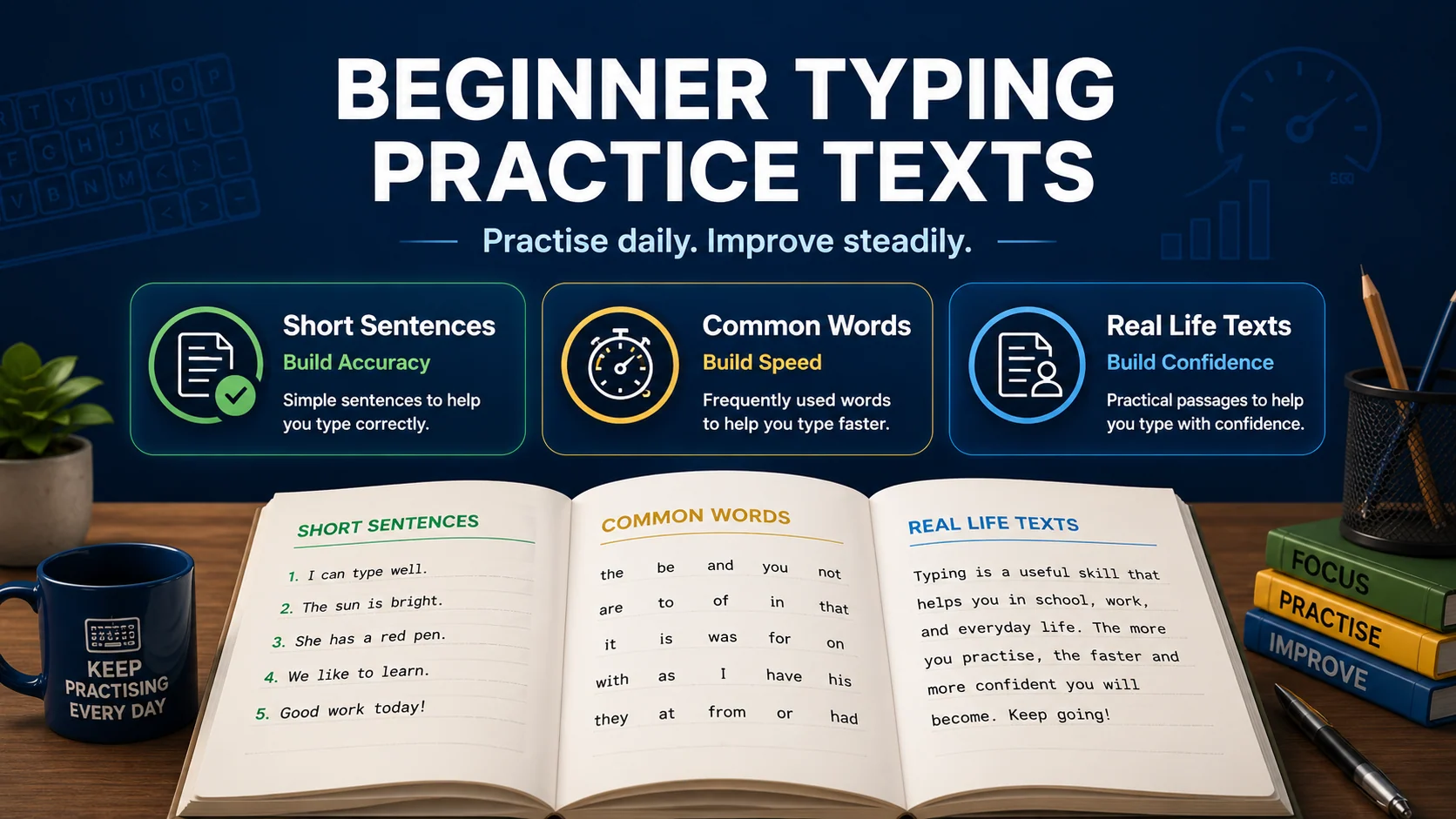
Beginner typing practice works best when the text is short, clear, and easy to repeat.
Long difficult paragraphs can overwhelm learners. Short practice texts help you focus on accuracy, rhythm, and confidence without getting lost.
Good beginner practice text should be simple enough to control, but realistic enough to be useful.
Use the practice texts below as short drills. Type slowly at first, then repeat with better rhythm.
How to use these practice texts
For each drill:
- Type slowly first
- Aim for accuracy
- Repeat the line
- Notice weak keys
- Try again with smoother rhythm
Do not rush. Clean typing is the goal.
Home row practice text
Use these when practising basic control.
A sad lad asks all.
Dad had a flask.
A salad falls fast.
Ask all lads.
Focus on hand position and returning fingers to the home row.
Short beginner sentences
These are useful for early sentence practice.
I can type with care.
Small steps build skill.
Good habits help daily work.
My hands stay calm.
I will practise a little today.
Type each sentence twice. Try to reduce mistakes the second time.
Accuracy practice texts
Use these to practise clean typing.
Accuracy comes before speed.
Clean typing saves time.
I can slow down and type clearly.
Every key press should feel controlled.
Good rhythm reduces mistakes.
The goal is not to type fast. The goal is to type correctly.
Rhythm practice texts
Use these to build a steady pace.
The task is simple.
I type each word with care.
A steady pace helps my hands.
Good rhythm makes typing easier.
Small daily practice builds confidence.
Do not rush easy words. Keep the pace even.
Weak-key practice texts
If you often miss r, u, b, or n, try these lines.
run turn under return
bring number under run
brown bread brings better balance
under the bright sun, Ben runs
Use the Weak Keys Practice tool to find your own weak keys.
Punctuation practice texts
Punctuation is important for real typing.
Yes, I can improve.
Wait, stop, and check.
Is this correct?
Today, I will practise typing.
Clean typing matters, especially at work.
Focus on commas, full stops, and question marks.
Capital letter practice texts
Capitals require Shift timing.
Tom can type.
Mia is ready.
Sam will practise today.
Kate wrote a clear note.
Alex can improve with daily practice.
Use the opposite Shift key where possible.
Office-style practice texts
Use these if you want typing practice for work.
Thank you for your message. I will check the details and reply later today.

Customer called at 10:30. Account details checked. Follow-up email sent.

The monthly report shows steady progress and fewer outstanding requests.
These help with real workplace typing.
Numbers and dates practice
Numbers are useful for admin, school, and everyday tasks.
Order 48291 was received on 14/06/2026.
The appointment is at 10:30 on Friday.
The total cost is £127.45.
Please call 020 5555 0198 after 2:00 pm.
Do not rush numbers. Accuracy matters.
Beginner paragraph practice
Use this when short sentences feel comfortable.
Typing improves with short daily practice. The goal is not to rush. The goal is to type clearly, keep your hands relaxed, and build confidence one line at a time.Repeat the paragraph and try to make each run cleaner.
A simple practice routine
Use this structure:
| Time | Activity |
|---|---|
| 2 minutes | easy warm-up text |
| 5 minutes | current lesson |
| 3 minutes | weak-key practice |
| 2 minutes | short test or paragraph |
After the session, write down one thing to practise next.
When to use typing tests
Use a one-minute typing test after practice to check progress.
Use a three-minute typing test when you want to check consistency.
Remember: tests measure skill. Practice builds skill.
How Qtype Pro helps
Qtype Pro gives learners structured lessons, practice, tests, and weak-key feedback.
You can use it to:
- follow a clear course
- practise beginner text
- track WPM and accuracy
- find weak keys
- build daily typing habits
Frequently asked questions
What should beginners type first?
Start with home row drills, short words, and simple sentences. Avoid difficult paragraphs too early.
Should practice text be easy?
At first, yes. Easy text helps build control. Increase difficulty gradually.
How many times should I repeat a drill?
Two or three careful repeats are usually enough. Focus on cleaner typing each time.
Should I practise numbers as a beginner?
Yes, but add them gradually after basic letter control improves.
Final thought
Beginner typing practice does not need to be complicated.
Use short texts, practise carefully, repeat weak areas, and build confidence one line at a time.