A good typing practice routine does not need to be long.
For beginners, the best routine is short, focused, and easy to repeat. You should practise accuracy, key control, weak keys, and rhythm before chasing high speed.
The best typing routine is the one you can repeat consistently.
This guide gives you a simple daily routine you can use to build touch typing confidence.
The quick answer
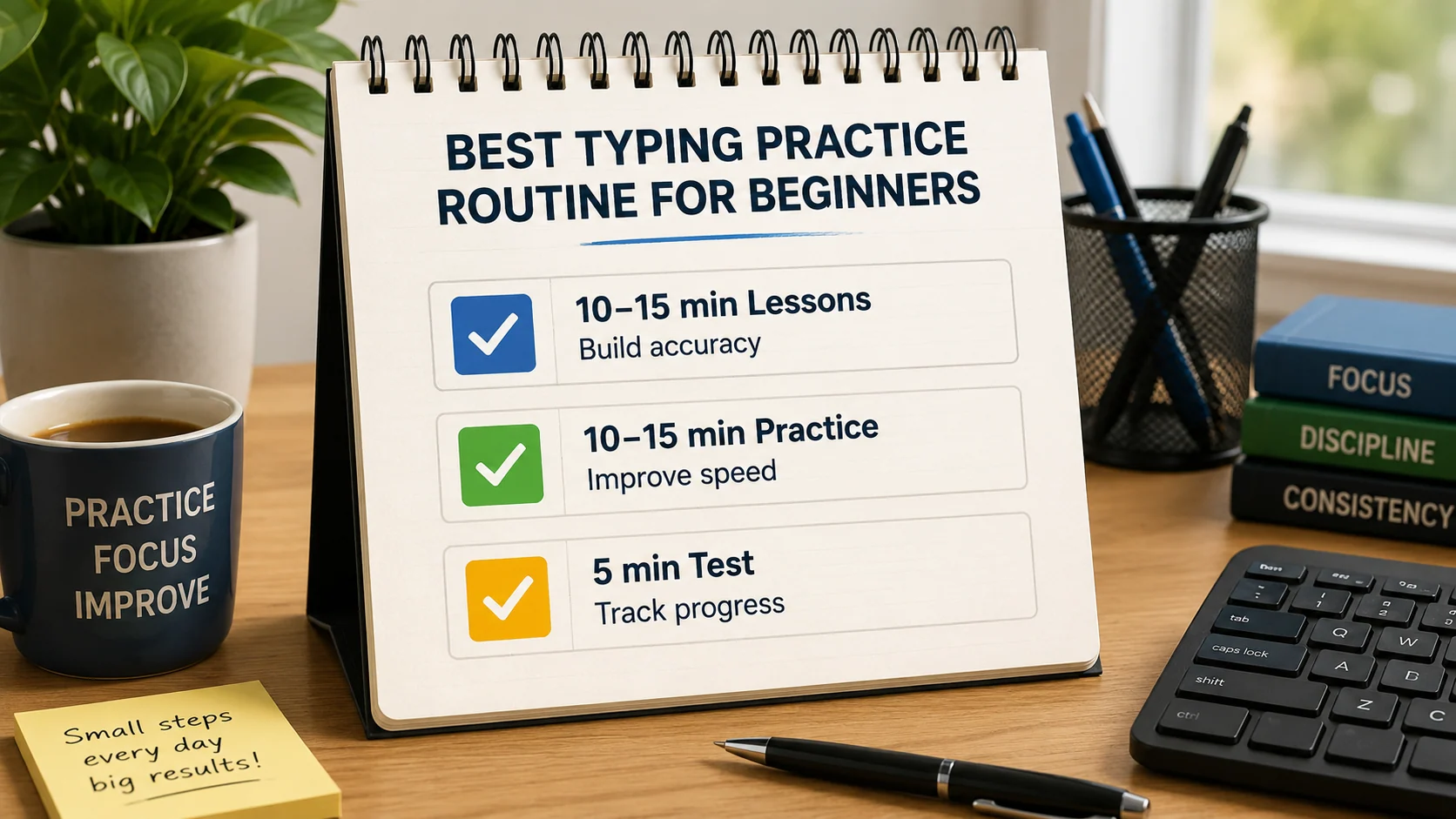
A strong beginner typing routine is:
| Time | Activity |
|---|---|
| 2 minutes | warm up with easy text |
| 5 minutes | practise your current lesson |
| 3 minutes | fix weak keys |
| 2–5 minutes | take a short test or copy burst |
| 1 minute | review mistakes |
That is around 10 to 15 minutes.
Why short practice works
Beginners often think they need to practise for hours. Long sessions can help sometimes, but they also create tired hands and careless mistakes.
Short sessions work well because they are:
- easier to start
- easier to repeat
- less tiring
- better for focus
- easier to fit into a normal day
A short session every day is usually better than one long session once a week.
Step 1: Warm up for two minutes
Start with easy text.
The warm-up should not be difficult. It should help your fingers settle into position.
Try:
I can type with calm hands.
Good habits build better typing.
Small daily practice helps progress.
Focus on relaxed hands and clean movement.
Step 2: Practise your current lesson
Spend around five minutes on your current lesson or key group.
Do not jump randomly around the keyboard. Follow a clear path.
A good lesson focus could be:
- home row
- top row
- bottom row
- capital letters
- punctuation
- numbers
- short sentences
If you are learning with Qtype Pro, continue the next lesson in your course.
Step 3: Practise weak keys
Weak keys are keys that cause repeated mistakes or hesitation.
Spend a few minutes on one weak area.
Do not try to fix everything at once.
Example weak-key drill:
run turn under return
bring number under run
clear careful correct control
Use the Weak Keys Practice tool to find what needs attention.
Step 4: Use a short typing test
A short test helps you measure progress.
Use a one-minute typing test after practice. Record your WPM and accuracy.
Do not take the test again and again hoping the score improves. One test is enough if you review it properly.
Ask:
- What was my accuracy?
- Which keys caused mistakes?
- Did I rush?
- Did punctuation slow me down?
- What should I practise tomorrow?
Step 5: Review before you finish
Spend one minute reviewing the session.
Write a simple note:
Today: 38 WPM, 96% accuracy.
Mistakes: r, u, comma.
Tomorrow: weak-key drill for r/u.
This makes the next session easier because you already know what to practise.
A full 7-day beginner routine
Day 1: Measure your starting point
Take a one-minute test. Write down WPM and accuracy.
Day 2: Accuracy practice
Use slow short sentences and aim for clean typing.
Day 3: Home row reset
Practise hand position and returning fingers to the home row.
Day 4: Weak keys
Choose one repeated mistake and practise it directly.
Day 5: Rhythm practice
Type short copy bursts at a steady pace.
Day 6: Punctuation and capitals
Practise simple real sentences.
Day 7: Review and test
Take a longer check with a three-minute typing test.
Want this as a guided habit? Try the 7-day typing challenge.
What beginners should avoid
Avoid these practice mistakes:
- starting with difficult paragraphs
- taking tests for the whole session
- chasing WPM before accuracy
- ignoring repeated mistakes
- practising when hands are tense
- looking at the keyboard for every key
- skipping review
Better practice is not harder. It is more focused.
How to know if your routine is working
Look for signs such as:
- fewer repeated mistakes
- better accuracy
- less looking down
- smoother rhythm
- more relaxed hands
- higher WPM over time
- more confidence in lessons
Progress is not always a straight line. Some days will be slower. The trend matters.
How Qtype Pro helps
Qtype Pro gives beginners a structured place to practise.
You can use it to:
- follow lessons in order
- practise daily
- track WPM and accuracy
- identify weak keys
- take typing tests
- stay motivated with games and achievements
Instead of wondering what to do next, you follow the next clear step.
Frequently asked questions
How long should a beginner practise typing each day?
10 to 15 minutes is enough for many beginners. Short daily practice is easier to maintain.
Should beginners take typing tests every day?
You can, but do not make tests the whole session. Lessons and weak-key drills are more important for building skill.
What should I practise first?
Start with posture, home row, and accuracy. Add new keys gradually.
How do I improve faster?
Practise consistently, keep accuracy high, fix weak keys, and review mistakes after each session.
Final thought
The best typing practice routine is simple.
Warm up. Practise one lesson. Fix one weak area. Take one short test. Review one thing.
Repeat that often, and your typing will become cleaner, faster, and more confident.