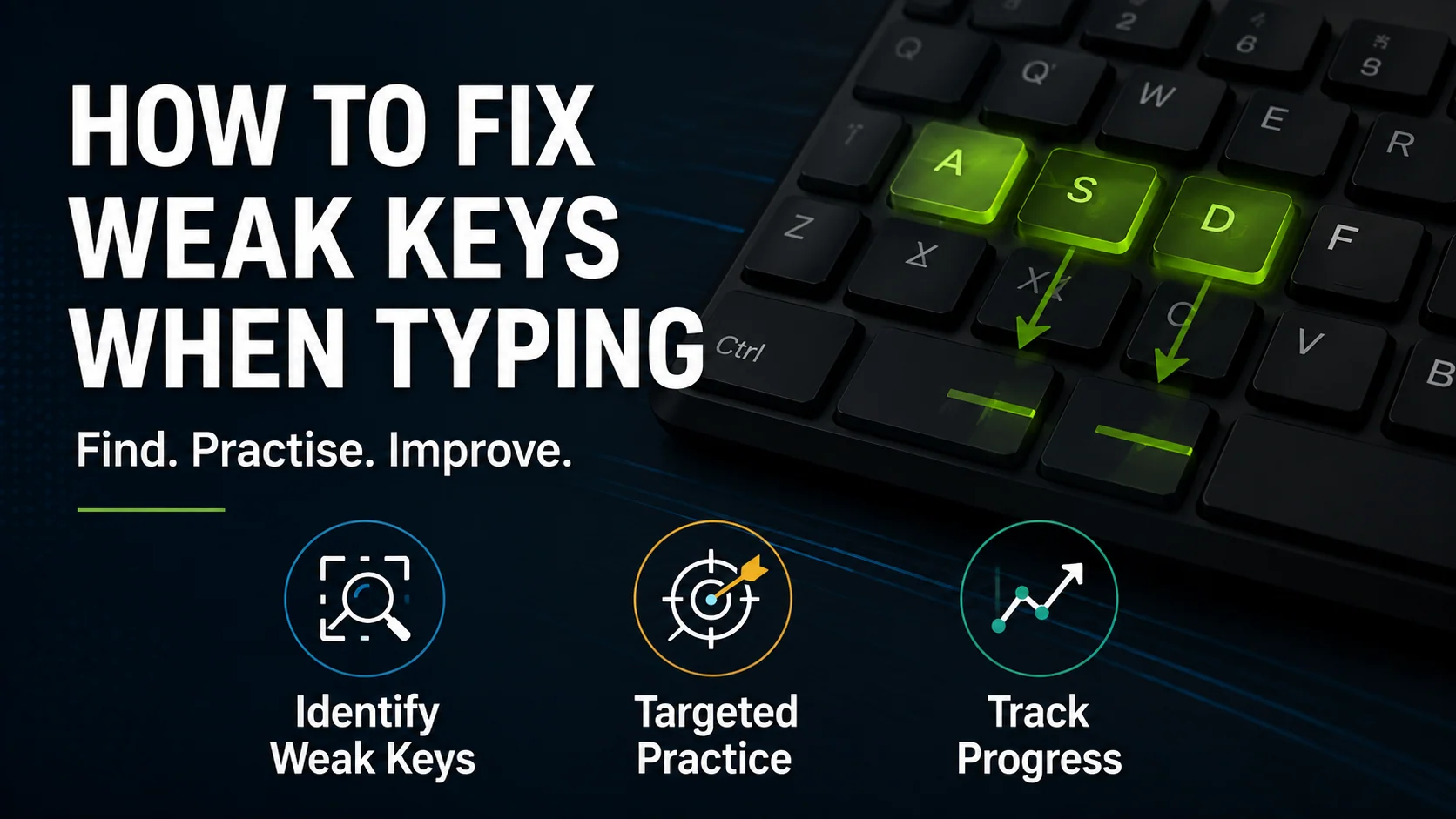
Weak keys are the keys you often press incorrectly, slowly, or with hesitation.
They can make typing feel frustrating because the same mistakes keep appearing again and again. You may take more typing tests, but the problem does not improve because the weak key has not been trained directly.
Weak keys improve faster when you practise the exact movement that causes trouble.
This guide shows you how to find weak keys and fix them with short practical drills.
The quick answer
To fix weak keys:
- Identify repeated mistakes
- Find the key, finger, or combination causing trouble
- Practise short focused drills
- Keep accuracy high
- Repeat over several sessions
- Test again and compare results
Do not try to fix every mistake at once. Choose one weak area and work on it clearly.
What counts as a weak key?
A weak key is not always a key you never know.
It can be a key that causes:
- repeated mistakes
- hesitation
- wrong finger movement
- looking down
- rhythm breaks
- extra backspacing
- tension in your hand
Common weak areas include:
- top row reaches
- bottom row reaches
- punctuation
- capital letters
r,u,b,n, orp- combinations like
th,ing,br, orun
Step 1: Find the pattern
After a typing test or lesson, do not only look at the final score.
Look for repeated errors.
Ask:
- Which keys did I miss?
- Did one hand make more mistakes?
- Did one finger feel uncertain?
- Did punctuation slow me down?
- Did I look down before certain keys?
- Did mistakes happen when I rushed?
You can use the Weak Keys Practice tool to identify problem keys.
Step 2: Slow the movement down
If a key is weak, rushing will usually make it worse.
Slow down and practise the movement correctly.
For example, if r is weak, do not type long random paragraphs hoping it improves. Practise small movements:
far red are run
red far run are
are run red far
The aim is to teach your finger the clean route.
Step 3: Use short drills
Weak-key drills should be short.
Long drills can become tiring, and tired typing creates more mistakes. A focused two-minute drill is often enough.
A good weak-key drill includes:
- the target key
- simple words
- repeated combinations
- short sentences
- calm rhythm
Example for u
sun run under use
under sun run use
I can use the key with care.
Example for b
bad bag bring bend
bring bend bag bad
The big bag is beside Ben.
Step 4: Practise pairs and combinations
Sometimes the problem is not one key. It is a combination.
Common difficult combinations include:
thingbrunpredion
Combination drill
bring bright break brown
under unit until useful
thing thinking nothing something
Type slowly and keep your rhythm even.
Step 5: Mix the key into real sentences
After practising a weak key alone, put it into normal text.
This helps transfer the skill into real typing.
Example:
I can bring the report under review.
The useful plan will improve accuracy.
Bright ideas need careful typing.
Do not jump straight from a drill to a fast test. Add realistic sentences first.
Step 6: Test again
After a few practice sessions, take a short test.
Use a one-minute typing test for a quick check.
Look at:
- whether the weak key improved
- whether accuracy increased
- whether hesitation reduced
- whether another key now needs attention
Weak-key practice is a cycle:
- Test
- Find mistake
- Practise
- Test again
How often should you practise weak keys?
A small amount every day works well.
Try this routine:
| Time | Activity |
|---|---|
| 1 minute | review mistakes |
| 2 minutes | weak-key drill |
| 2 minutes | short sentence practice |
| 1 minute | quick check |
You do not need to spend the whole session on weak keys. Just include them regularly.
Common weak-key mistakes
Avoid these habits:
- repeating full tests without targeted practice
- rushing the weak key
- practising too many weak keys at once
- ignoring accuracy
- looking down every time
- giving up after one session
- practising only isolated letters
Weak keys usually need several short sessions, not one long push.
How Qtype Pro helps
Qtype Pro helps you identify and practise weak areas.
You can use it to:
- track mistakes
- review weak keys
- practise targeted drills
- take typing tests
- build accuracy over time
- follow structured lessons
Instead of guessing, you can see what needs attention.
Frequently asked questions
Why do I keep pressing the same wrong key?
Your finger may have learned the wrong movement or may be reaching from the wrong starting position. Slow practice and focused drills can correct it.
Should I practise weak keys every day?
A few minutes a day can help. Short regular practice is usually better than one long session.
Should I practise letters or words?
Use both. Start with letter combinations, then practise words and short sentences.
How do I know a weak key is fixed?
It is improving when mistakes reduce, hesitation drops, and you can use the key in normal sentences without looking down.
Final thought
Weak keys do not fix themselves just because you take more tests.
Find the pattern. Slow down. Practise the exact movement. Add the key into real sentences. Then test again.
Small focused drills can remove big typing bottlenecks.