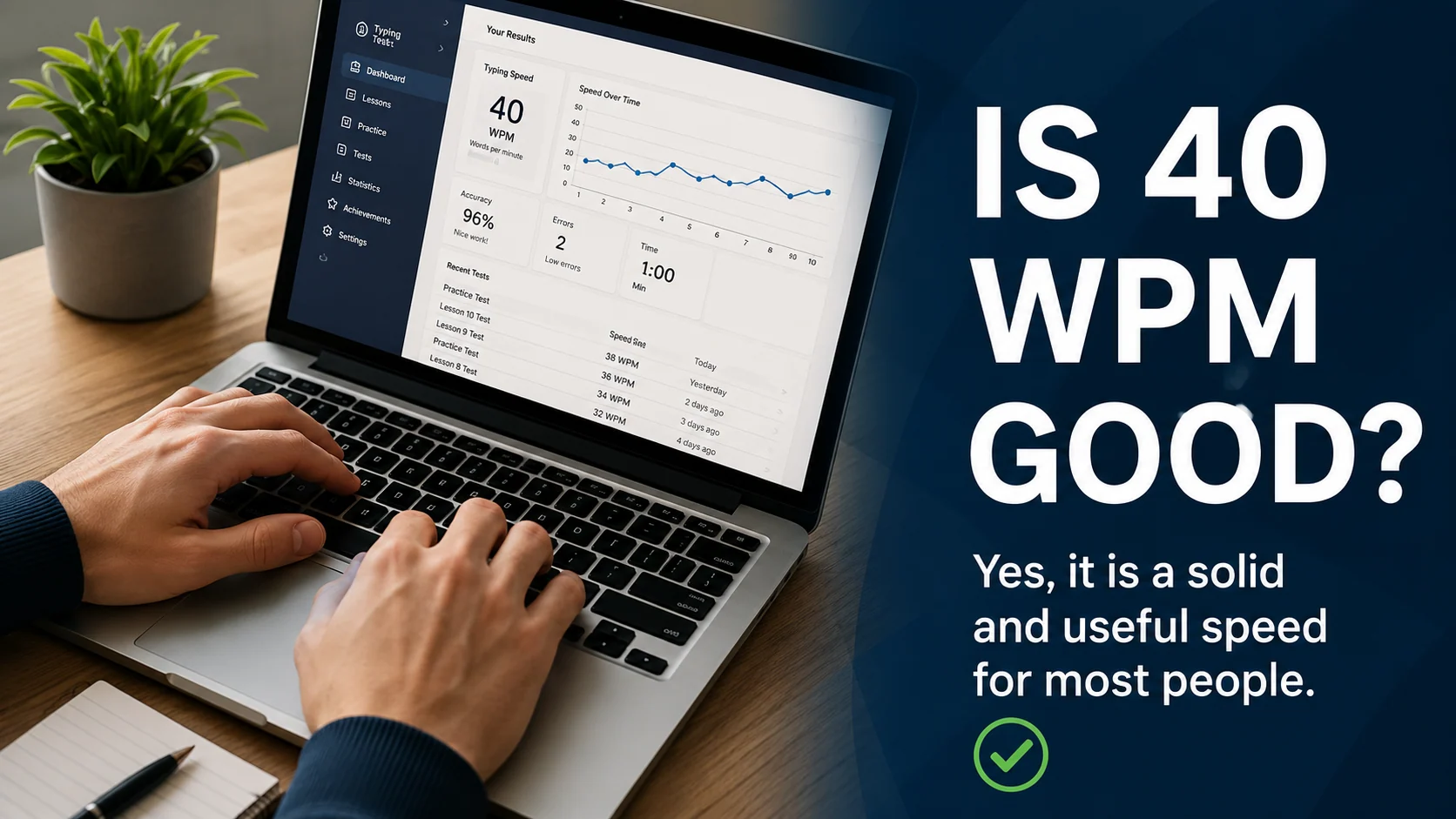
Yes, 40 WPM is good for many everyday typing tasks, especially if your accuracy is high.
At 40 words per minute, you can usually handle emails, online forms, messages, short documents, school tasks, and many basic office duties. It may not be extremely fast, but it is useful and practical.
40 WPM with strong accuracy is better than a higher speed full of mistakes.
This article explains what 40 WPM means, when it is enough, when you may want to improve further, and how to build towards 50 WPM or more.
The quick answer
40 WPM is good for:
- everyday emails
- general computer use
- online forms
- short documents
- school or college work
- many admin tasks
- basic office typing
40 WPM may feel slow for:
- heavy data entry
- transcription
- live note-taking
- busy customer support
- long reports
- typing-heavy admin roles
For many learners, 40 WPM is a strong milestone. The next practical target is usually 50 WPM with 95%+ accuracy.
What does 40 WPM mean?
WPM means words per minute.
Typing at 40 WPM means you can type around 40 standard words in one minute. In typing tests, one word is usually counted as five characters, including spaces.
But your full result should include accuracy.
Compare these results:
| Result | Practical value |
|---|---|
| 40 WPM, 98% accuracy | Strong and useful |
| 40 WPM, 85% accuracy | Needs accuracy work |
| 55 WPM, 88% accuracy | Fast but messy |
| 50 WPM, 96% accuracy | Stronger practical typing |
A clean 40 WPM result is more useful than a messy faster result.
Is 40 WPM good for office work?
40 WPM can be good enough for many office jobs.
It is useful for:
- writing emails
- updating records
- filling forms
- typing short notes
- preparing simple documents
- internal messages
- basic admin work
However, if a role involves constant typing, you may want to improve beyond 40 WPM.
For office jobs, a useful range is often 40 to 60 WPM with high accuracy.
You can read more in What Typing Speed Is Useful for Office Jobs?.
Is 40 WPM good for students?
Yes. 40 WPM is useful for many students.
It can help with:
- essays
- notes
- homework
- research
- online learning
- emails
- revision materials
If you are typing long assignments regularly, improving from 40 WPM to 50 or 60 WPM can make writing feel smoother.
Is 40 WPM good for beginners?
For a beginner, 40 WPM is a very good milestone.
Many learners start below this, especially if they are switching from looking at the keyboard to proper touch typing.
If you have reached 40 WPM, focus on making it stable.
Ask yourself:
- Can I repeat 40 WPM consistently?
- Is my accuracy above 95%?
- Do I look at the keyboard often?
- Do punctuation and capitals slow me down?
- Can I type for three minutes without losing control?
If the answer is yes, you have a strong foundation.
When 40 WPM is not enough
40 WPM may not be enough if the job or task is very typing-heavy.
You may want a higher speed for:
- data entry
- transcription
- legal secretary work
- medical secretary work
- customer service chat
- live note-taking
- high-volume admin
In these situations, aim for 50 to 60 WPM or more with good accuracy.
Why accuracy still matters at 40 WPM
Do not treat 40 WPM as good if mistakes are high.
In real work, errors cost time. You may need to correct names, numbers, dates, addresses, and messages.
A useful 40 WPM result should include:
- 95%+ accuracy
- controlled punctuation
- comfortable capital letters
- relaxed hands
- fewer repeated mistakes
Good typing is not just speed. It is speed you can trust.
How to improve from 40 WPM to 50 WPM
The best way is not to force your fingers to move faster.
Use this plan:
- Take a one-minute typing test
- Review your mistakes
- Practise weak keys
- Use short rhythm drills
- Repeat daily for 10 to 15 minutes
- Take a three-minute typing test once a week
Rhythm drill
I can type with steady control.
Clean movement helps speed grow.
Forty words per minute is a strong base.
Type smoothly. Do not rush the first few words.
Practice areas to improve beyond 40 WPM
Focus on the areas that usually slow learners down:
- weak keys
- punctuation
- capital letters
- top row reaches
- bottom row reaches
- looking at the keyboard
- uneven rhythm
- too much backspacing
Use the Weak Keys Practice tool to find your problem keys.
A simple 7-day plan
Day 1: Measure
Take a one-minute test. Write down WPM and accuracy.
Day 2: Accuracy
Practise short sentences slowly and cleanly.
Day 3: Weak keys
Practise the keys that caused mistakes.
Day 4: Rhythm
Type short copy bursts at a steady pace.
Day 5: Punctuation
Practise commas, full stops, and capital letters.
Day 6: Longer check
Take a three-minute test.
Day 7: Review
Compare results and choose one focus for next week.
Want a guided habit? Try the 7-day typing challenge.
Frequently asked questions
Is 40 WPM slow?
No. 40 WPM is not slow for many everyday users. It is a useful typing speed if your accuracy is good.
Should I put 40 WPM on my CV or resume?
Only include typing speed if it is relevant to the job. If you do, include accuracy or say “accurate typing” rather than only listing WPM.
How do I get from 40 to 60 WPM?
Practise daily, fix weak keys, reduce looking down, and build rhythm gradually. Do not sacrifice accuracy for speed.
Final thought
40 WPM is a good and useful typing milestone.
If your accuracy is strong, it can support many work, study, and everyday tasks. Once it feels comfortable, build towards 50 WPM with the same clean control.