What Typing Speed Should a 10-Year-Old Have?
If your 10-year-old types at 12, 15 or 20 words per minute, is that good?
There is no single speed that every child should reach by the age of ten. A child who has been using a keyboard regularly for three years has a big head start over someone who has mainly used a tablet and has only just started learning to type.
Still, a few published benchmarks can give parents a useful reference point.
What is a normal typing speed for a 10-year-old?
Typing.com gives an approximate range of 8–20 words per minute (WPM) for elementary-school students in grades 3–5.
Typing Pal groups children aged 6–11 together and suggests these training targets:
- 15 WPM for a beginner;
- 25 WPM for an intermediate learner;
- 35 WPM for an advanced learner.
Sources: Typing.com – WPM / Averages Grade Level and Typing Pal – Typing Speed
For a 10-year-old who is still learning, somewhere around 15–20 WPM with reasonable accuracy is a perfectly sensible place to be.
It is not a target that every child has to meet. Some will be faster and some considerably slower.
The more useful question is whether their typing is becoming easier and more accurate over time.
Is 10 WPM too slow for a 10-year-old?
Not necessarily.
If a child has only recently started using a physical keyboard, 10 WPM is simply a starting point.
Watch what happens while they type.
Do they spend several seconds looking for each letter? Do they type mainly with their index fingers? Are they trying to remember where the keys are?
If so, speed is not really the problem yet. They are still learning the keyboard.
A child who goes from 8 WPM to 11 WPM while looking at the keyboard less often has made useful progress, even if 11 WPM still looks low on a speed chart.
Is 20 WPM good for a 10-year-old?
Yes. For many 10-year-olds, 20 WPM with good accuracy is a solid result.
It sits at the upper end of Typing.com's approximate 8–20 WPM elementary-school range.
But accuracy changes the meaning of that score.
Consider these two results:
- 20 WPM with 96% accuracy;
- 26 WPM with 78% accuracy.
The second child produced more keystrokes, but also made far more mistakes.
For schoolwork, the first result may be more useful. Constantly stopping to correct spelling and typing errors interrupts writing and can erase much of the time gained by typing faster.
Typing.com recommends at least 85% accuracy for elementary-school learners. That is a useful minimum reference, although a child practising regularly should gradually aim higher.
Our guide Typing Accuracy vs Typing Speed: Which Matters First? explains why building clean typing habits first usually makes improving speed easier later.
What should you look for besides WPM?
A typing test is useful, but it cannot tell you everything about a child's technique.
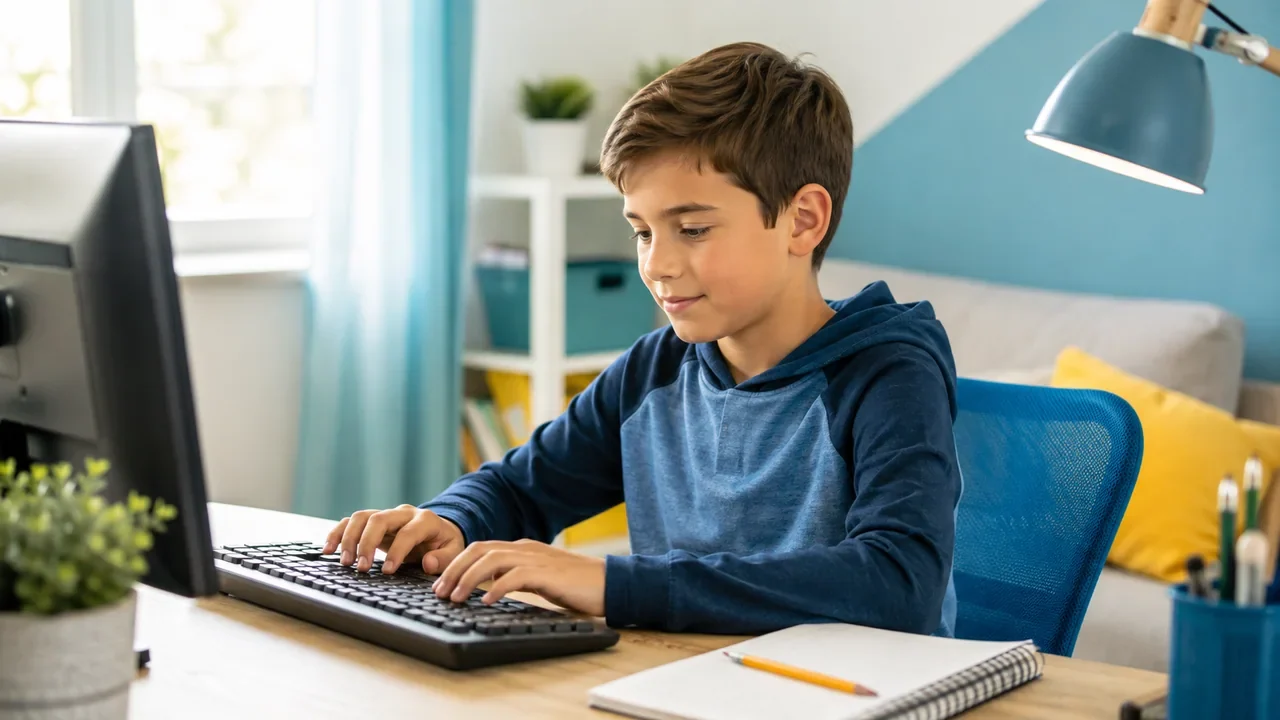
Watch them type for a minute or two.
Are they using several fingers?
A child does not need perfect touch-typing technique on day one.
However, moving away from one-finger or two-finger typing is an important step. Proper finger placement reduces the distance each finger has to travel and eventually makes typing much more automatic.
Are they constantly looking at the keyboard?
Occasional glances are normal for a learner.
Looking down for almost every letter means the keyboard layout has not become familiar yet. In that situation, practising key positions is more useful than pushing for higher WPM.
Are the same keys causing mistakes?
Repeated errors are valuable information.
If r, t, p or another group of keys keeps causing trouble, the learner does not necessarily need another full typing test. They need practice on those particular movements.
The Qtype Pro weak-key checker can help identify repeated problem keys and turn them into focused practice.
Does their typing look controlled?
This is easy to overlook.
A child hammering at the keyboard and racing through every exercise may produce a higher WPM result for a minute. A child typing calmly with a steady rhythm is usually building a better long-term habit.
How quickly should a 10-year-old improve?
There is no useful answer such as "five WPM every month."
Children start from very different places.
Instead, record a baseline.
For example:
| Date | WPM | Accuracy |
|---|---|---|
| 5 September | 12 | 87% |
| 19 September | 14 | 93% |
| 3 October | 17 | 95% |
That tells a much better story than looking at one result.
The child has gained five WPM, but more importantly, the faster typing has not come at the cost of accuracy.
You can get a starting result with the free Qtype Pro 1-minute typing test. No account is required.
There is little benefit in testing every day. Test, practise for a while, then test again.
How much should a 10-year-old practise?
Typing practice does not need to take over the school day.
For most children, a short session that keeps their attention is more useful than sitting at the keyboard until they are bored.
A simple session could look like this:
- Spend a few minutes on the current keys or lesson.
- Practise short words using those keys.
- Slow down when mistakes start appearing.
- Finish with a short sentence or phrase exercise.
- Stop while the child is still concentrating.
Ten or fifteen focused minutes can be plenty.
The important part is regularity. A short practice block several times during the week gives the learner repeated exposure to the keyboard without turning typing into a chore.
For families learning at home, Touch Typing for Homeschool: Simple Weekly Plan gives you a ready-made weekly structure.
You can also visit Qtype Pro's homeschool typing page for a guided approach to adding keyboard practice to the week.
Should a 10-year-old learn proper touch typing?
This is a good age to start.
Children are beginning to use keyboards for longer pieces of schoolwork, but their typing habits may not yet be deeply established.
The aim should not be to force perfect technique immediately.
Start with:
- where the fingers belong;
- which fingers control which keys;
- using more than one or two fingers;
- returning to a comfortable starting position;
- gradually reducing the need to look down.
Speed can develop as those movements become familiar.
If a child currently types quickly with two fingers, learning proper technique may even make them slower for a while. That is not a reason to abandon it. They are replacing an old habit with a new one.
Do not compare children too closely
Two 10-year-olds can have completely different keyboard histories.
One may have used a laptop every day since the age of seven. Another may be opening a laptop mainly for schoolwork for the first time.
Comparing their WPM scores tells you very little about how well either child is learning.
Use published ranges to get your bearings, then compare the child with their own previous results.
If they were typing at 11 WPM last month and are now reaching 15 WPM with fewer errors, things are moving in the right direction.
That matters more than whether another child can type at 25 WPM.
Frequently asked questions
Is 15 WPM good for a 10-year-old?
Yes, particularly for a child who is still learning. Typing Pal uses 15 WPM as its beginner target for children aged 6–11, while Typing.com's broader elementary-school range is 8–20 WPM.
Is 20 WPM good for a 10-year-old?
Yes. Twenty WPM is around the upper end of Typing.com's approximate range for elementary-school learners. Check the accuracy as well as the speed.
Should a 10-year-old be able to touch type?
A 10-year-old does not need to be an accomplished touch typist, but it is a good time to learn correct finger placement and begin reducing dependence on looking at the keyboard.
What accuracy should a 10-year-old aim for?
Typing.com recommends at least 85% accuracy for elementary-school students. Once a child is comfortable with the keyboard, aiming above 90% gives a better foundation for increasing speed.
Start with a score, then work on the typing
If you want one simple answer, 15–20 WPM with reasonable accuracy is a useful reference point for a 10-year-old who is learning to type.
Do not turn it into a pass mark.
Start with the child's current result. Look at their accuracy and technique. Practise for a couple of weeks and measure again.
A child moving steadily from 12 to 15 to 18 WPM while becoming more accurate is doing exactly what you want to see.
Take the free Qtype Pro 1-minute typing test to record a starting WPM and accuracy score.