How Much Typing Practice Should a Child Do Each Day?
Children do not need to spend an hour at the keyboard every day to become better typists.
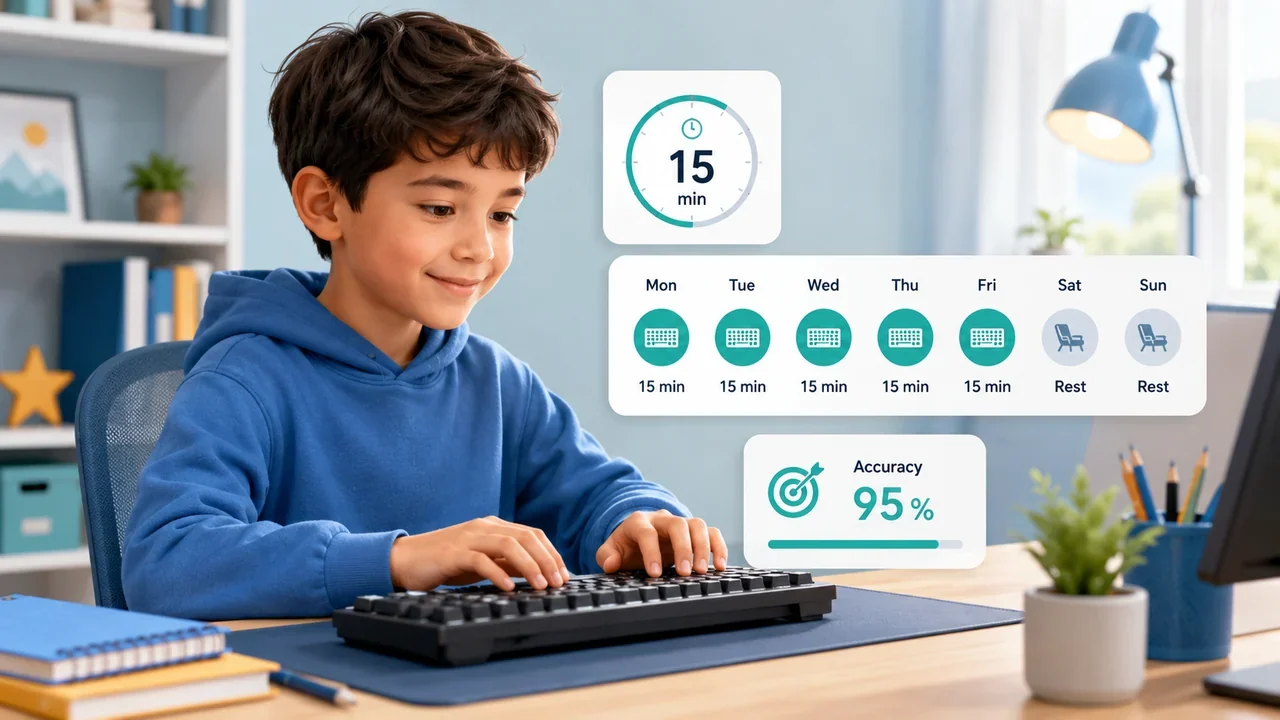
For most learners, 10 to 20 minutes of focused typing practice on a practice day is plenty.
Younger beginners may do better with sessions closer to 10 minutes. Older children who can concentrate for longer can often manage 15–20 minutes comfortably.
The important part is not squeezing in as many minutes as possible.
It is practising often enough for the keyboard movements to become familiar without continuing so long that concentration and technique start to fall apart.
How long should a child practise typing?
A practical starting point is:
| Learner | Suggested session length |
|---|---|
| Young beginner | 5–10 minutes |
| Primary-school learner | 10–15 minutes |
| Older child / teenager | 15–20 minutes |
| Experienced learner | 15–25 minutes |
These are not strict rules.
A focused eight-minute session can be more useful than twenty minutes spent looking around the room, rushing through exercises or repeatedly typing the wrong keys.
Typing Pal recommends short 15–20 minute sessions and suggests at least one hour of practice across the week.
Source: Typing Pal – How long does it take to learn to type?
Typing.com makes a similar point without prescribing a particular number of minutes. Its guidance says that regular short bursts of practice are more effective than a few longer sessions, and that too much practice can lead to poorer attention and technique.
Source: Typing.com – WPM / Averages Grade Level
So you do not need to make typing a large lesson.
A little practice, repeated regularly, is enough to build momentum.
Does a child need to practise every day?
No.
Daily practice can work well if the sessions are short, but it is not essential.
For many families, four or five practice days each week is easier to maintain.
For example:
| Day | Practice |
|---|---|
| Monday | 10–15 minute lesson |
| Tuesday | 10-minute practice |
| Wednesday | Rest or other schoolwork |
| Thursday | 10–15 minute lesson |
| Friday | Short review or typing game |
| Weekend | Optional |
That gives the learner repeated contact with the keyboard without making typing something they have to do every single day.
Typing Pal's recommendation of at least an hour of weekly practice can easily be spread across four 15-minute sessions.
The precise schedule is less important than consistency.
Why are short sessions better?
Typing is partly a movement skill.
The learner is trying to make particular finger movements familiar enough that they eventually happen without much conscious thought.
Repeating those movements helps.
Repeating them badly does not.
Imagine a child starts a lesson sitting properly and concentrating.
For the first ten minutes they are:
- using the correct fingers;
- watching their accuracy;
- keeping a steady rhythm;
- correcting mistakes carefully.
After twenty-five minutes they may be:
- slouching;
- looking down at the keyboard constantly;
- pressing keys with whichever finger is closest;
- racing to finish;
- making the same errors repeatedly.
More minutes have been completed, but the quality of the practice has dropped.
This is why it makes sense to stop while the learner is still practising properly.
Devon County Council's guidance on developing keyboard skills also recommends establishing good posture from the beginning and building the habit of taking regular breaks.
Source: Devon County Council – Developing keyboard skills
What should happen during a 15-minute typing session?
A child does not need to spend the whole session doing the same exercise.
A simple 15-minute routine could look like this:
Minutes 1–3: warm up
Start with familiar keys or an easy lesson.
The aim is to get the fingers moving accurately rather than immediately testing maximum speed.
Minutes 4–10: main lesson
Work on the current lesson or key group.
This should be the main part of the session.
If a new key is being introduced, allow the learner to slow down.
Minutes 11–13: problem keys
Spend a few minutes on letters that caused repeated mistakes.
There is little value in practising the whole keyboard equally if two or three keys are responsible for most of the errors.
The Qtype Pro weak-key checker can help identify repeated problem keys and turn them into focused practice.
Minutes 14–15: finish with something comfortable
End with a short sentence, easy exercise or quick review.
Finishing on an exercise the child can manage helps prevent every session from feeling like a test.
That is enough.
You do not need to add another half hour because the computer is already switched on.
Should children take a typing test every day?
Probably not.
Typing tests measure progress. They do not create most of the progress.
A child who spends all their practice time repeatedly taking speed tests may get very good at trying to beat a number without fixing the technique that limits them.
Use a test as a checkpoint.
For example:
- Take a starting test.
- Record WPM and accuracy.
- Practise normally for one or two weeks.
- Take the same length test again.
- Compare the results.
You might see something like this:
| Date | WPM | Accuracy |
|---|---|---|
| 3 September | 15 | 89% |
| 17 September | 17 | 94% |
| 1 October | 20 | 96% |
That shows useful improvement.
The learner is not simply typing faster. They are becoming more accurate at the same time.
You can use the free Qtype Pro 1-minute typing test to record a baseline.
For help interpreting the result, read Typing Speed by Age: What WPM Should Children and Adults Aim For?.
What if the child wants to practise for longer?
That is fine if they are still engaged and their technique remains good.
Twenty minutes is not a safety limit.
Some children enjoy typing and will happily continue for longer.
The question is whether the extra time is still useful.
Watch for signs that the session has gone on too long:
- accuracy suddenly falls;
- the child starts hammering the keys;
- they stop using the correct fingers;
- posture becomes poor;
- they repeatedly look away from the exercise;
- frustration increases;
- they begin rushing simply to finish.
At that point, stop.
A break is more useful than forcing another lesson.
What if ten minutes is already too much?
Make the session shorter.
This is especially important with younger children.
Five good minutes every school day still gives you 25 minutes of useful keyboard practice across a week.
Once the learner becomes more comfortable, you can increase the session gradually.
There is no benefit in making a child dislike typing because a timetable says the lesson must last fifteen minutes.
Accuracy should decide the pace
Speed is easy to measure, so children naturally want to improve it.
Do not let the daily session become a race.
If a learner can type at:
18 WPM with 96% accuracy
and then tries to reach:
25 WPM with 78% accuracy
the higher number is not necessarily progress.
Reduce the pace and restore clean typing first.
The article Typing Accuracy vs Typing Speed: Which Matters First? explains why accuracy is such an important foundation.
How should typing fit into a homeschool day?
Typing works well as a small regular block rather than a large standalone subject.
It could fit:
- before English;
- after morning reading;
- alongside computing;
- between two longer subjects;
- before an online lesson;
- at the beginning of independent work.
For example:
09:00 – Maths
09:45 – Break
10:00 – 15 minutes typing
10:15 – English
That is enough to make typing part of the routine without allowing it to dominate the timetable.
Our Touch Typing for Homeschool: Simple Weekly Plan gives a fuller example.
If you are still choosing how to teach typing at home, read Homeschool Typing Program: What Should Parents Look For?.
Is five days a week better than one long weekly session?
Usually, yes.
Imagine two children both practise for one hour each week.
The first child practises:
60 minutes on Saturday
The second practises:
15 minutes on Monday, Tuesday, Thursday and Friday
Both have completed the same amount of time.
The second learner gets four separate opportunities to recall the finger positions and reinforce the movements.
That is closer to the kind of frequent short practice recommended in current typing-training guidance.
A literature review published by Typing Pal also cites recommendations for frequent 15-minute sessions over an extended period rather than relying on intensive short-term practice.
Source: Typing Pal – Literature Review
Frequently asked questions
Is 10 minutes of typing practice enough?
For a young learner, yes.
Ten focused minutes several times a week can provide plenty of useful practice, particularly when the child is learning basic finger placement and key positions.
Is 15 minutes of typing practice enough?
Yes.
Fifteen minutes is a very practical session length for many school-age learners. Typing Pal recommends short 15–20 minute training sessions.
Should children practise typing every day?
They can, but they do not have to.
Four or five short sessions each week can work very well. The important thing is to practise regularly rather than doing one very long session occasionally.
Can a child practise typing too much?
Yes.
Once attention drops, technique and accuracy may deteriorate. Typing.com's guidance specifically warns that over-training can reduce alertness and lead to poorer technique.
How soon should typing speed improve?
There is no fixed timetable.
Some children improve quickly at first, while others spend longer becoming comfortable with finger placement.
Look for improvements in accuracy, confidence and technique as well as WPM.
When should children start practising touch typing?
For many children, primary-school age is a good time to begin, once they are using a physical keyboard regularly and can concentrate on short exercises.
Read When Should Children Start Learning Touch Typing? for more detail.
Keep the routine small enough to last
You do not need an ambitious typing schedule.
For most children, start with 10–15 minutes at a time.
Older or more experienced learners can move towards 15–20 minutes if they remain focused.
Practise several times during the week. Keep accuracy visible. Work on mistakes instead of endlessly repeating full tests. Stop when concentration starts to disappear.
A routine that a child can follow for months is far more useful than an intensive practice schedule that lasts one week.
For homeschool families, start with the Qtype Pro homeschool typing page, or use the free 1-minute typing test to record a starting WPM and accuracy score.